Global Summer School
A two-week summer school delivered entirely online during the pandemic, bringing together around 350 students from across the world. Recognised with an NTU award for team excellence.

The brief
The Global Summer School normally runs in person. During the pandemic it had to run fully online: around 350 students, joining from countries across the world, taking courses spanning a wide range of disciplines, across two weeks.
The teaching material was not the difficult part. The difficulty was everything around it. A cohort who had expected to travel, share a campus and meet each other were now going to experience all of it through a screen, and a large proportion of them had never used the university's systems before.
My role
I coordinated the online sessions and designed the learner experience across the programme, from how students were brought into the learning management system (LMS) through to the badging that recognised their participation.
How I approached it
The first decision was to assume no familiarity at all. When someone has never used the LMS, the first thing they meet cannot be course content. So the programme opened with orientation: where things are, what happens when, what is expected, and what to do when something does not work. With a two-week programme there is no recovery time. If you lose someone in the first hour, you have lost them for a fortnight.
Coordinating live sessions across that many time zones was a scheduling problem and a design problem at once. Anything that could be asynchronous was, so that live time was reserved for what really needed people in the same room. Those sessions were built around discussion and activity rather than delivery, because a lecture that could have been a recording is a poor use of the one thing that is actually scarce.
Building a community on screen
Community was the part that needed the most deliberate design. In person it happens by accident, in corridors and over coffee. Online it only happens if you build somewhere for it and give people a reason to be there. With 350 students from different disciplines who had never met, that meant designing the social structure as carefully as the academic one.
We used Flipgrid, a Microsoft tool for sharing short videos, as a closed group for the cohort, a little like a private version of TikTok. New topics went up regularly, chosen to be easy and enjoyable to answer: the food where you live, your hometown, local stories and legends. Nobody needed any knowledge of a subject to join in, which put everyone on equal footing whatever they were studying. A short video is also far easier to post than an essay, and it lets people see and hear each other, which is much of what a campus would normally give them. Unfortunately, Flipgrid has since been retired by Microsoft, which is why the original topics are no longer online.
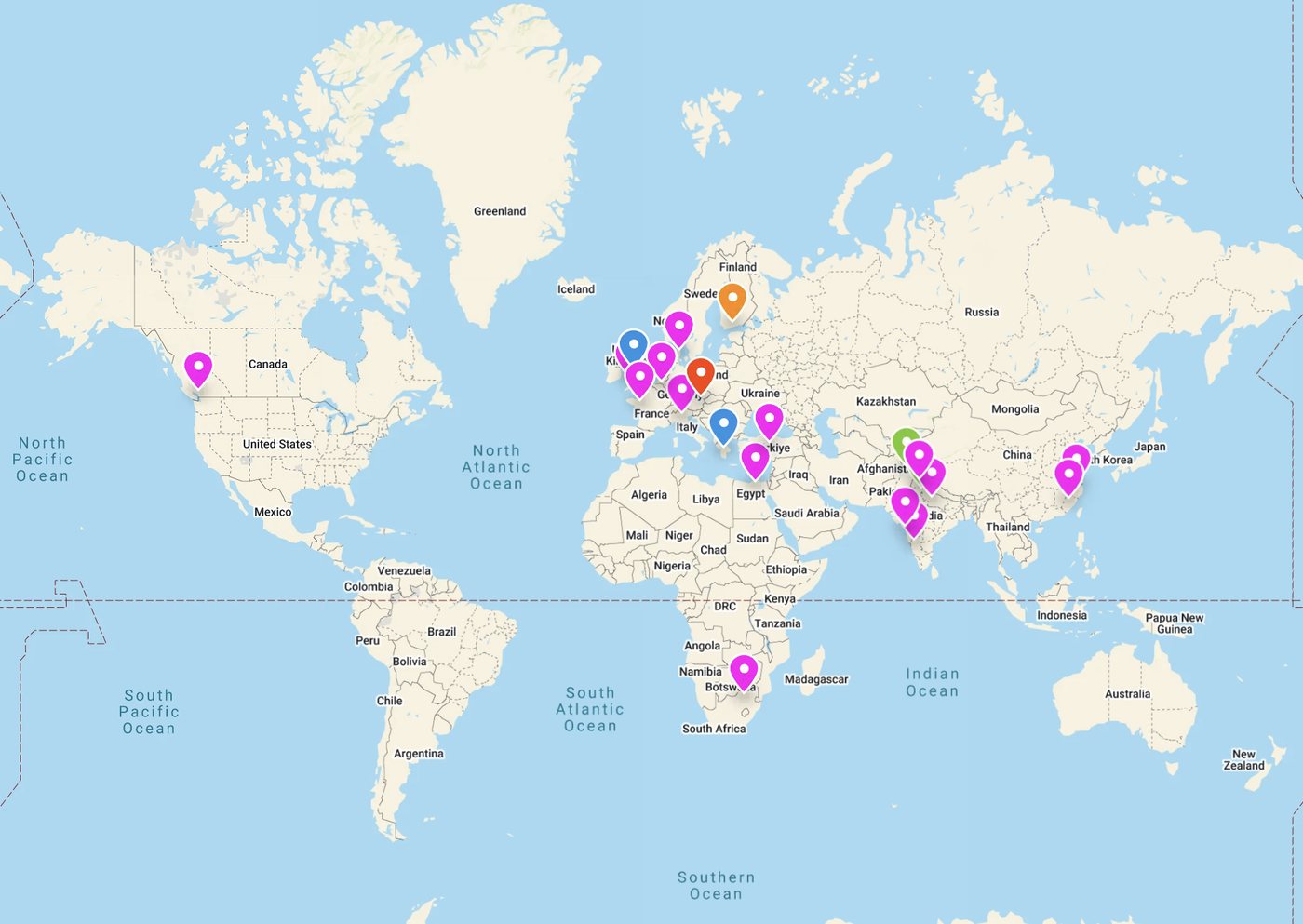
We also set up a map where participants could choose to pin where they were joining from. Seeing the pins spread across several continents helped a cohort of individuals on separate screens see themselves as one group. Pinning was optional, so nobody had to share more than they were comfortable with.
Recognising progress with badges
Students received an overall badge recognising their participation in the summer school. Badges were set up to release automatically when learners completed certain tasks, so recognition arrived straight away, without anyone having to track who had done what and hand them out. On a programme with no graduation, no campus and no shared photograph at the end, a visible marker of having been part of it does more work than it might sound. Because so many learners were new to the platform, there was also a short "How to access your badge" page. The badge itself, which I designed, is at the top of this page.
From badges to a guide for staff
I am interested in gamifying learning, and seeing how badges could be used led me to write a guide for academics and other staff on using the university's awards tool to gamify a module. It explains what open badges are and how students can use them, how to design a badge that makes sense to someone outside the course, and how to set up badges to release automatically. It also sets out four things a badge can recognise: attainment, participation, engagement and completion, so that staff can choose the one that fits what they want learners to do.
The guide is the university's document, so I cannot publish it here, but I am happy to talk through how it is structured.
Outcome
The programme ran across the full two weeks with around 350 students taking part from countries around the world.
The work was recognised at NTU's internal awards, winning an award for team excellence and receiving a highly commended at the same ceremony.