Stepping into Leadership
A three-week open course on FutureLearn for people moving into their first leadership role in higher education, designed around social learning and built to fit a text-heavy platform.
The brief
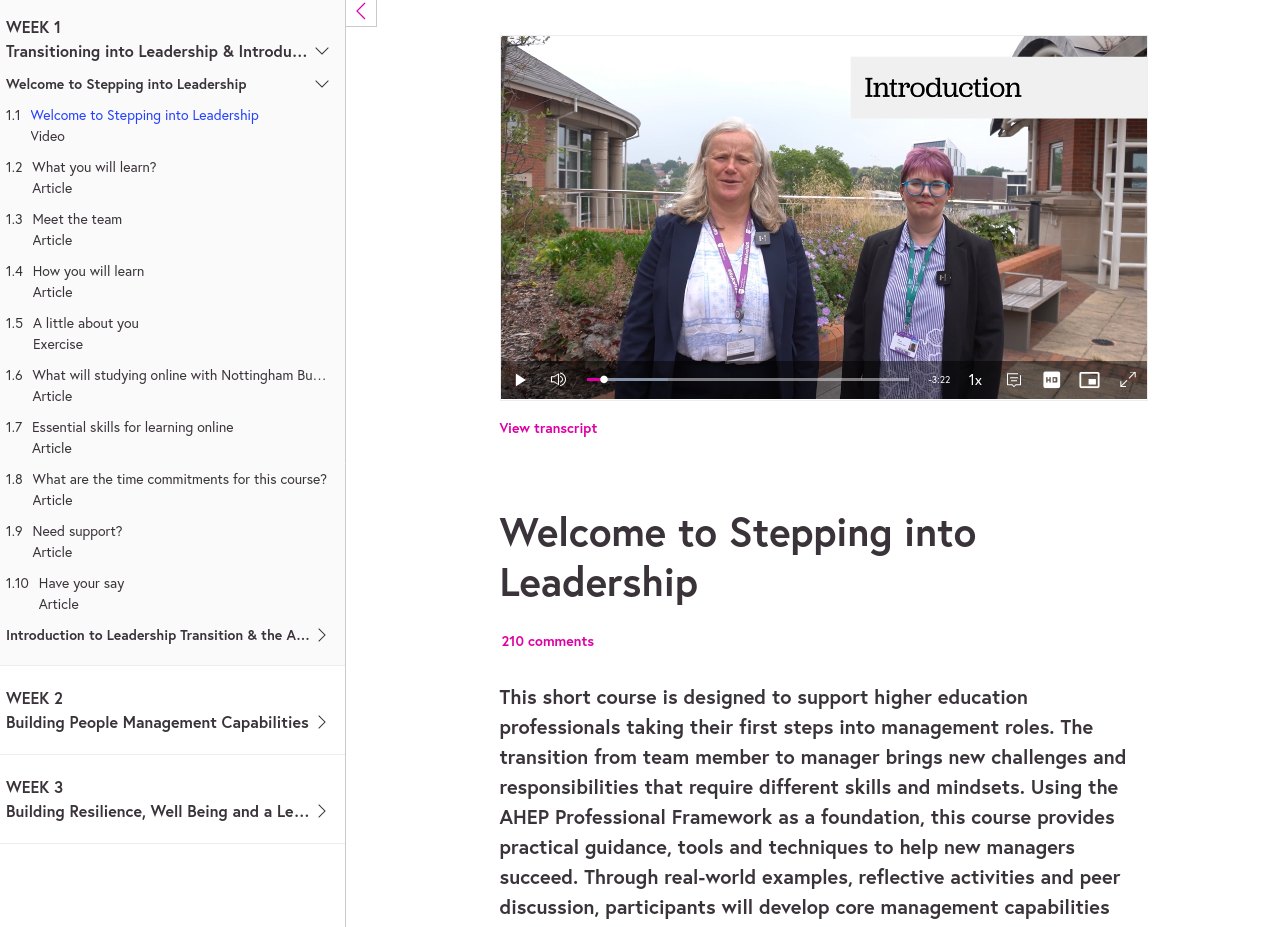
Nottingham Business School wanted an open course on FutureLearn for people stepping into a leadership role in higher education for the first time. Aligned to the AHEP framework, three weeks long, free to enrol. The catch was the platform. FutureLearn runs on social learning: every step has a discussion sitting alongside it, and the platform itself is mostly text and video. Any interactive activity has to be embedded through a hosted link.
My role
I designed and built the course end to end with the academic team as subject experts. That covered the structure, the pacing across three weeks, the writing of every step, and the interactive activities that sit inside the text.
How I approached it
I started by mapping the course using ABC Learning Design with the SMEs, so we agreed the shape of the three weeks and where the learners needed to arrive before any writing began. From there I paced the material around the discussion rather than treating it as an afterthought, so learners hit a conversation point after every substantial piece of content and could bring their own context into it.
For the interactive activities I built a small set in H5P and embedded them through hosted links. These were structured reflection prompts and short scenario responses, with automated feedback where it added something, and an exportable reflection document that learners could take with them into their first leadership role. On a text-heavy platform, a few well-placed interactions do more than trying to make everything interactive.
The shape of the course
Week 1 Transitioning into Leadership and Introducing the AHEP Framework
Week 1, 16 steps: 2 videos, 11 articles, 1 exercise, 1 poll, 1 discussion.Week 2 Building People Management Capabilities
Week 2, 10 steps: 1 video, 6 articles, 1 exercise, 1 poll, 1 discussion.Week 3 Building Resilience, Wellbeing and a Leadership Plan
Week 3, 11 steps: 2 videos, 5 articles, 1 exercise, 1 poll, 2 discussions.- Video 5
- Article 22
- Exercise 3
- Poll 3
- Discussion 4
The course runs to 37 steps over three weeks: 22 articles, 5 videos, 4 discussions, 3 polls and 3 exercises. The map is built from the course outline itself, and a few decisions show up in the pattern.
Orientation comes first. Week 1 opens with ten steps about the course itself, before any leadership content: who is teaching, how learning works on the platform, how much time it takes and where to get support. Someone fitting study around a full-time job is more likely to stay if the first week answers "how does this work?" before the content begins.
Learners measure themselves. Before the video introduction, Weeks 2 and 3 each open with a short poll asking learners to rate their current understanding of the week's topic. It gives them a starting point to compare against when the week ends.
The last two weeks build towards something the learner makes. In Week 2 it is a written reflection on how they delegate and how they like to receive feedback, written in a tool they can export and keep. It is not assessed, so it stays a safe place to think honestly, and the step alone has drawn more than 50 comments from learners comparing how they work. In Week 3 it is a personal leadership development action plan, which learners then share in discussion.
Outcome
The course is live and open to anyone. It has been rated 4.7 out of 5 by learners with over 2,000 enrolments. See the course on FutureLearn.
“Charlotte made it incredibly pain free, slick and most enjoyable with her friendly, open and can do attitude and approach to designing something new. She was great at communicating and the process was devoid of anything that was box ticking and overly administrative. [She] made the filming great fun. Her feedback on ways to improve was well delivered and well received.”

What I would do differently
Given more time, I would have built one longer branching activity for the trickiest part of the course, where new managers first have to have a difficult conversation with someone they used to work alongside. That is the moment the course points at, and a scenario would let learners practise it rather than just read about it.