AI Trailblazer
Piloting a closed-loop AI tutor inside online modules, with custom JavaScript that keeps the model answering only from verified module content.
The brief
The AI Trailblazer modules were the university's test of an integrated large language model (LLM), the kind of AI behind tools like ChatGPT, inside its learning management system (LMS), drawing only on the content within each learning room, so it could answer only from material students had actually been taught. The idea was to give learners a tutor for general queries. The real design question sat elsewhere: what could this actually do for learning if you built the prompts properly?
My role
I did not build the underlying tool. I designed the pedagogical framework around it and built the custom JavaScript that injects structured prompts, so the model only responds within the content it has been given.
How I approached it
I focused on three things a well-scoped AI tutor can actually do for a learner: reflection, summarisation, and short branching scenarios. For each I wrote a fixed prompt that framed the model's role, and used a custom textbox so students could type the specific week or topic they were working on and press a button to send the full prompt, their input already sitting inside it.
I built the same pattern for reviewing a student's written reflection against established reflection models (Kolb, Gibbs), so the AI checked the student's own reflection against a framework they had already been taught. The design work was in the fixed wording around the injection point, not the injection itself.
The two tools
These are the two tools from a working recreation I built, shown mid-use. The prompts are lightly tidied versions of the ones actually used, and the responses are scripted examples so the focus stays on the prompt design. If you would like to try them for yourself, the working demo is here.
A revision aid
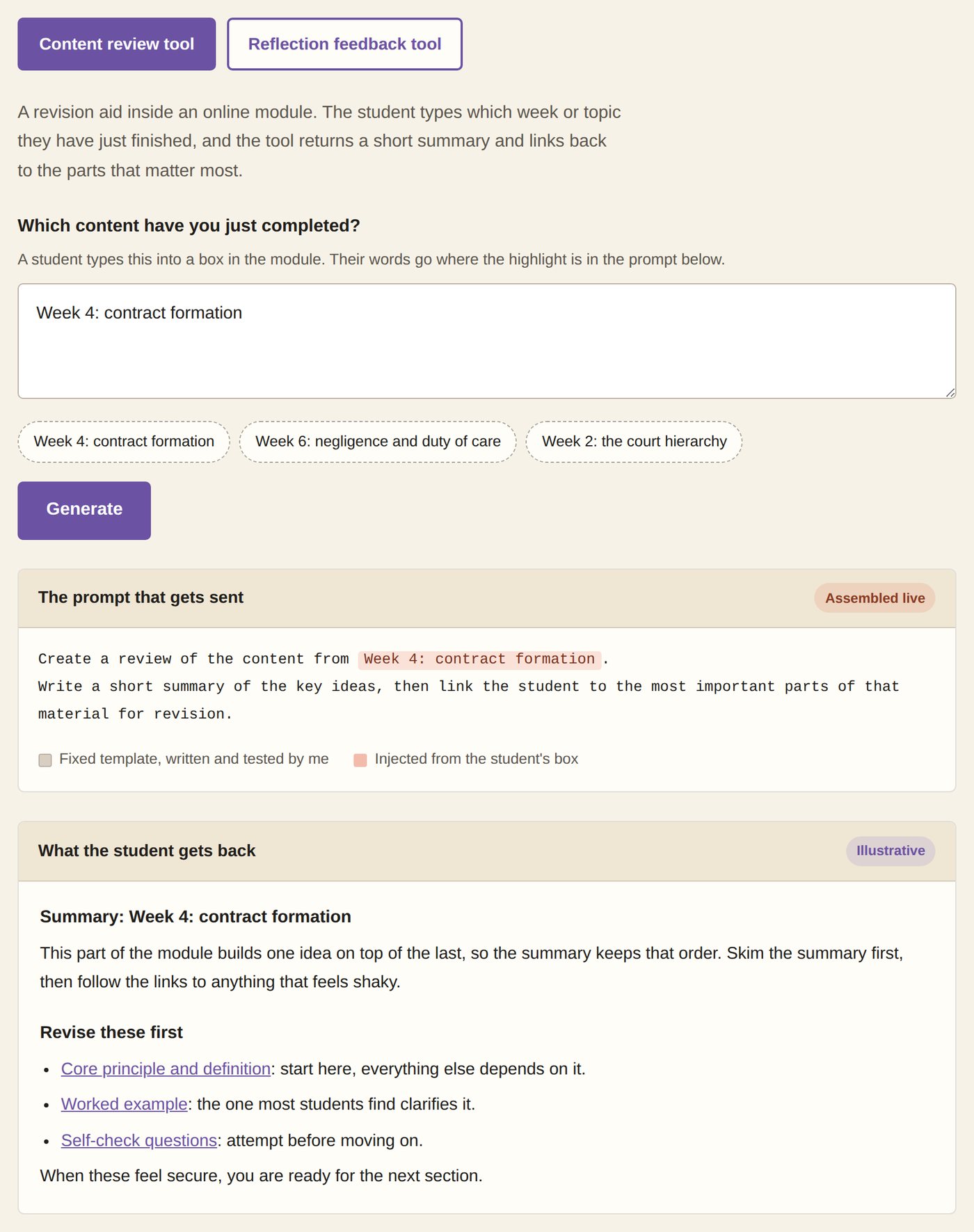
A student who has just finished a week of study types in what they covered, and the tool returns a short summary with links back to the parts worth revisiting. The student only ever supplies the part that changes. Everything around it is a fixed prompt I wrote and tested, so nobody can accidentally ask the AI the wrong question, and it stays focused on the module, whatever a student happens to type. The demo highlights exactly where their words land, which makes that design visible.
Feedback on a written reflection
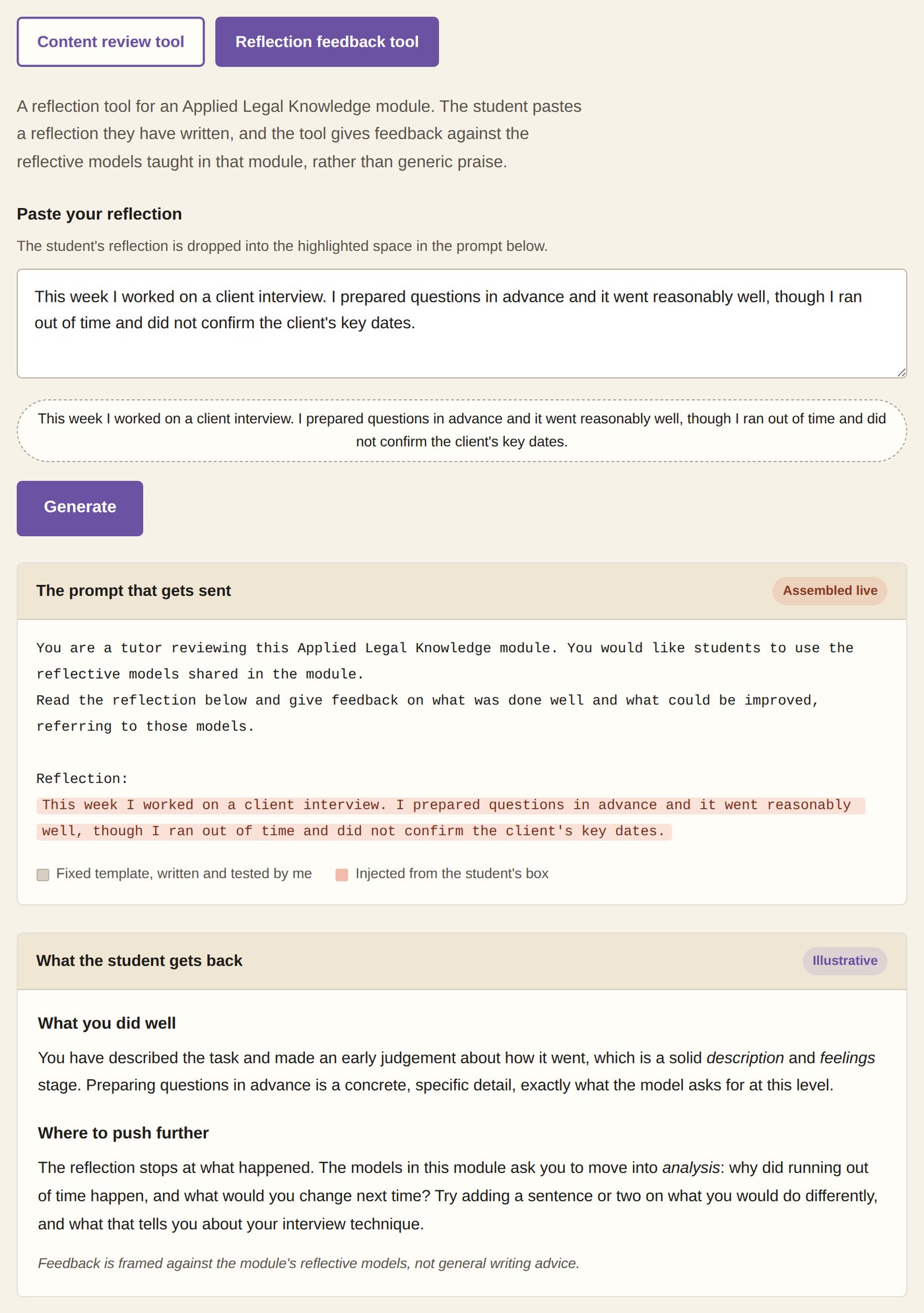
Students paste in a reflection they have written and get feedback measured against the reflective models taught in the module, which is far more useful than general praise. Because the prompt names the module's own models, the AI checks the student's thinking against a framework they have already been taught instead of inventing one. That keeps the feedback in line with what tutors would say, and nudges students past describing what happened towards working out why, and what they would do differently.
Outcome
The tools were built and ready to launch. The university then decided not to take the wider AI tool forward, so they did not go into production. The prompt design work, and the pedagogical thinking around what an AI tutor should and should not be asked to do, is what I take forward from it.
“I would also like to thank Charlotte for all of her hard work on this module. The enhancements developed during the consultation period have been extremely successful. In fact, we have since rolled these changes out across all Games Art modules.”
What I would do differently
Given the same pilot again, I would push earlier on evaluating the model's actual answers against the fixed prompts, so we had evidence of where the scaffolding held and where it quietly slipped, rather than trusting the injection alone. That evaluation is more important than the injection itself.